 Back to all articles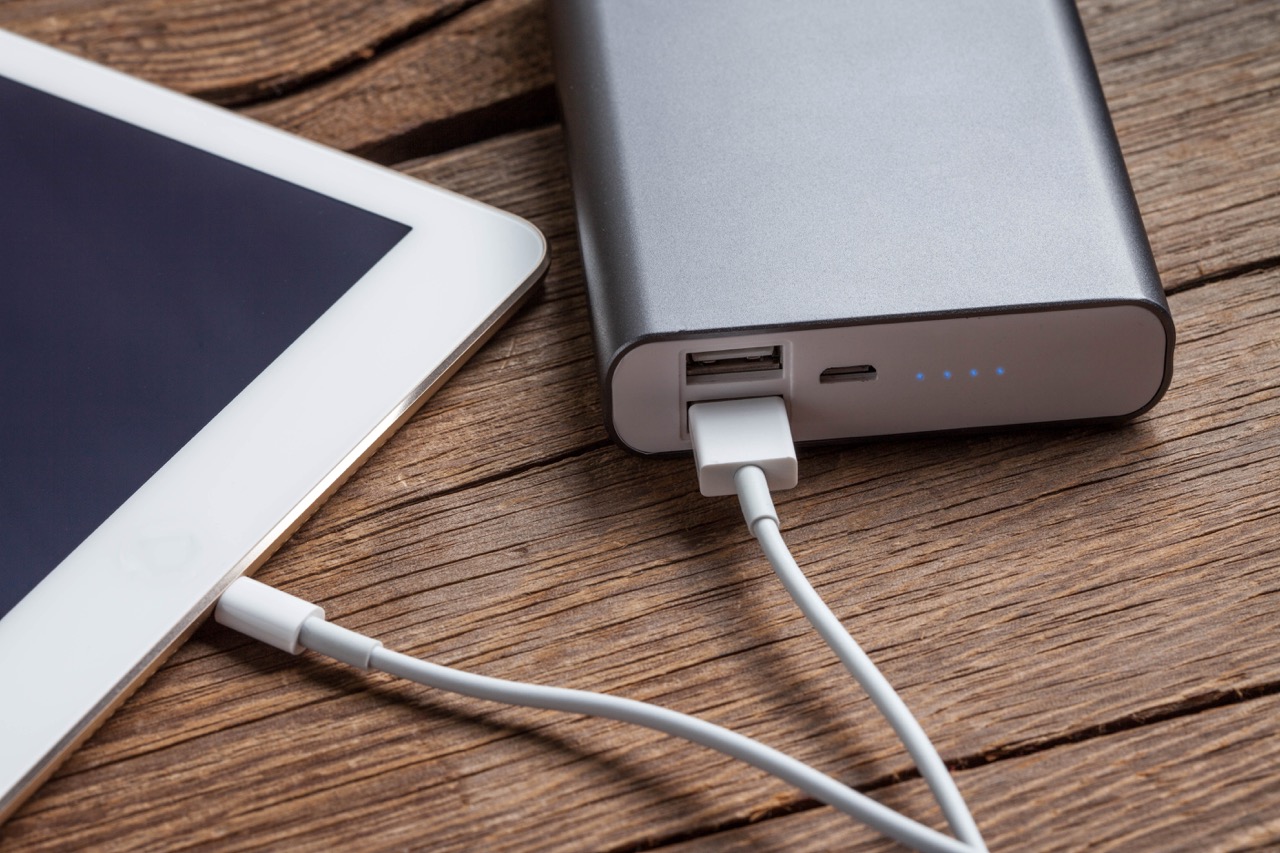



Can You Take Power Banks on a Flight?
Yes, you can normally take power banks on a flight if they are below 100Wh. Power banks above 100Wh typically need airline approval before taking them on a flight. You should never place these in checked luggage.
Quick rule: ✅ Carry-on = allowed (within limits) ❌ Checked baggage = not allowed
In most cases, the key takeaway is simple:
- Power banks must be packed in your carry-on (not checked luggage)
- There are limits based on watt-hours (Wh), not just mAh
- Some airlines apply stricter rules than the general TSA/ICAO guidance
Power banks are considered spare lithium batteries, which means they’re not allowed in checked luggage. Keep them in your cabin bag or personal item so, if something overheats, it can be handled quickly. Many airlines are now strongly advising passengers not to place power banks in overhead compartments. Instead, portable chargers should remain either:
- on the passenger’s person, or
- inside a personal item stored underneath the seat in front.
Keeping lithium-ion batteries nearby and visible allows cabin crew to respond more quickly if a battery overheats or catches fire during the flight.
Below, we’ll break down what’s allowed, how to check your power bank rating, and the safest way to pack it so you’re not delayed at security or forced to throw it away at the gate.
New Airline Rules for Power Banks in 2026
Many airlines are introducing stricter rules for how passengers use and store power banks during flights. Recently a UK-bound EasyJet flight was diverted to Rome after a power bank was found to be charging in a passenger’s luggage. Authorities said a portable power bank was the likely cause of a fire that destroyed a passenger plane in South Korea, leaving three people with minor injuries.
Depending on the airline, passengers may now be asked to:
- keep power banks visible while charging devices
- avoid charging devices inside bags
- avoid storing power banks in overhead compartments
- stop using portable chargers during the flight
- avoid charging power banks using in-seat USB ports
These rules vary between airlines and regions, particularly across Asia-Pacific carriers where battery-related safety measures have tightened significantly.
India has gone further than most: the Directorate General of Civil Aviation has banned both using and charging power banks in-flight on all routes, not just recommending it. If you’re flying to or from India, plan to leave your charger switched off in the air, not just packed away.
Passengers should always check their airline’s latest battery policy before traveling. Some airlines have already updated their official guidance around portable chargers and lithium batteries.
Understanding Airline and TSA Regulations
Regulations for power banks on a flight are specific and vary between airlines. Generally, airlines view power banks as spare batteries. The Transportation Security Administration (TSA) requires placing these in your carry-on bag. Checked luggage isn’t an option for power banks.
Airlines follow guidelines issued by the FAA for flights within the United States. These guidelines ensure safety during travel. It’s always wise to verify any additional rules your airline might enforce regarding power banks. Checking beforehand can prevent misunderstandings at the airport.
Power Bank Capacity: What You Need to Know
When bringing power banks on a flight, it’s crucial to understand the capacity limits imposed. Manufacturers measure the capacity of power banks in milliampere-hours (mAh) or watt-hours (Wh).
Here’s a quick breakdown of the regulations:
- Below 100Wh: Generally allowed
- 100Wh to 160Wh: Requires airline approval
- Above 160Wh: Not allowed
Always have the power bank’s capacity clearly labeled for easy identification during security checks. This step will help ensure a smooth travel experience.
Why Is There Regulation Around Power Banks?
Strict regulations exist for a good reason. The primary concern behind these rules is safety. Power banks contain lithium-ion batteries, which, if damaged or improperly stored, pose a fire risk.
Risk of Thermal Runaway
Lithium-ion batteries can overheat and enter a dangerous state called thermal runaway. This occurs when a battery short-circuits or is exposed to extreme heat, leading to smoke, fire, or even explosions. Since aircraft cabins are confined spaces, such incidents can be hazardous.
With the risk and usage of power banks now increasing, some airlines are tightening their restrictions.
Packing Your Power Bank: Carry-On vs. Checked Luggage
When traveling by air, knowing where to pack your power bank is essential. You should never place these in checked luggage. They must always be in your carry-on bag.
This rule helps prevent potential safety hazards. It also ensures that your power bank is accessible throughout the journey. In the event of a battery issue, being in the cabin allows the crew to manage the situation promptly.
Remember to store your power bank in an easy-to-reach location. You might need to present it during security screenings. Having it ready will speed up the process and reduce inconvenience.
It’s Not Just Power Banks
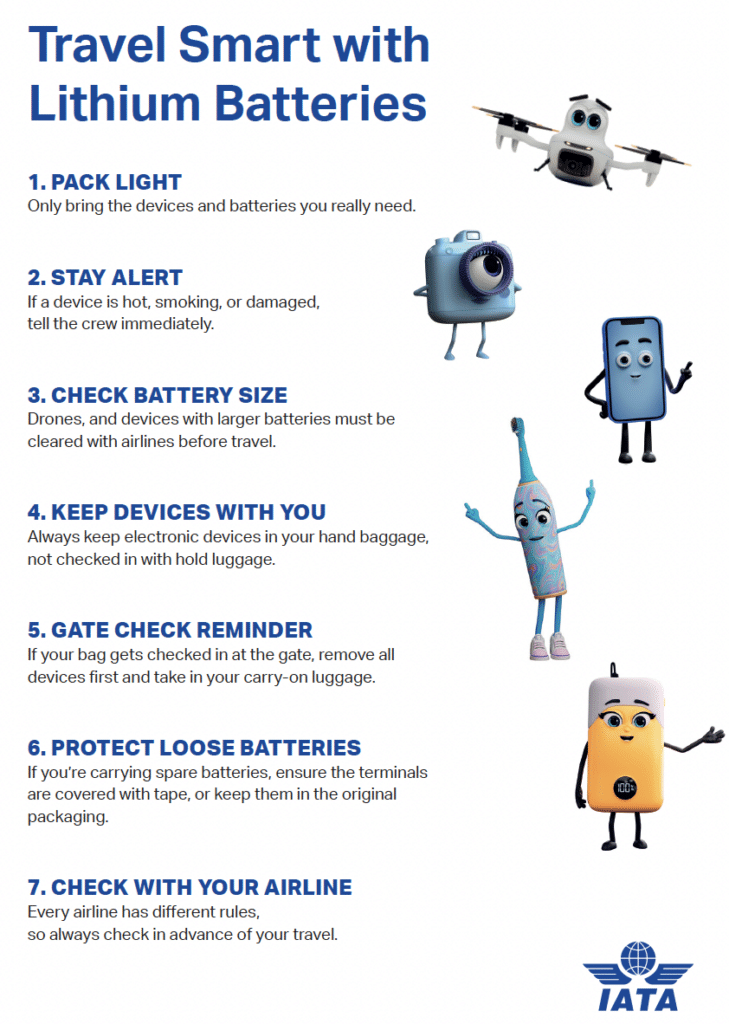
The International Air Transport Association’s (IATA) own guidance doesn’t stop at power banks. Phones, laptops, tablets, cameras, e-reader – anything with a lithium battery is meant to travel in the cabin too, not checked.
If your carry-on bag gets gate-checked at the last minute, the rule is the same for all of it: take out your phone, laptop, power bank, camera, and any spare batteries first and keep them with you in the cabin.
IATA has a simple one-page reference covering the core rules for flying with lithium batteries, handy to screenshot before your next trip:
Tips for Traveling with Power Banks
Some useful tips to consider before you travel:
Know your watt-hours (Wh) before you fly
Airline limits are based on watt-hours, even if your power bank is marketed using mAh. Many travelers assume any size is fin, but limits do apply.
Before you pack:
- Check the label for Wh
- If only mAh is shown, convert to Wh before you fly
- If there’s no label, some airlines may not accept it
If the rating is hard to read, take a quick photo of the label before you travel.
Prevent short circuits
A power bank can become a safety issue if its ports or terminals touch metal (keys, coins, loose cables). To reduce risk:
- Keep it in a protective case
- Avoid tossing it loose in a bag with chargers or metal objects
- Don’t pack it where it can be crushed (like the bottom of an overstuffed backpack)
If your carry-on gets gate-checked, remove the power bank first
This is one of the most common mistakes for travelers: your cabin bag is fine until the airline decides it needs to go in the hold at the last minute.
If your bag is being gate-checked:
- Take out your power bank (and any spare lithium batteries)
- Keep them with you in the cabin
Don’t bring damaged power banks
If a power bank is cracked, leaking or has been dropped hard, leave it at home. If it gets unusually hot, smells strange or starts smoking:
- Stop using it immediately
- Move it away from other items if safe to do so
- Tell cabin crew right away
This is rare, but it’s exactly why airlines want power banks accessible in the cabin, not buried in the cargo hold.
Check your airline’s rules before you fly
Many airlines follow international lithium battery guideline, but some apply stricter policies, including:
- Lower size limits
- Limits on how many power banks you can bring
- Restrictions on using or charging power banks onboard
If you’re flying internationally, it’s worth checking your airline’s policy page to avoid surprises. Enjoy using your devices without interruptions during your journey.
View our previous article on using USB luggage power ports.
Airlines Powerbank Rules
Here are some of the most popular airlines’ rules on power banks:
Emirates’ Power Bank Safety Rules
Emirates has recently updated its policy on carrying and using power banks onboard. Compared to most airlines, these rules are stricter and worth paying attention to if you are flying with them:
- Carry-on only: Power banks are prohibited in checked luggage.
- Capacity limit: Each passenger may bring only one power bank under 100Wh.
- No usage onboard: Passengers cannot use power banks to charge devices or recharge the power bank during the flight.
- Placement rule: Power banks must be stowed in the seat pocket or under the seat. They may not be placed in overhead bins.
- Clear labeling: The power bank must visibly display its capacity rating.
These rules were introduced after a surge in lithium battery-related safety incidents in aviation. Emirates aims to reduce the risk of overheating and ensure cabin crew can respond quickly if a battery problem occurs.
American Airlines (USA)
- Carry-on only (as spare lithium batteries)
- Up to 100Wh: Allowed
- 100Wh–160Wh: Allowed with airline approval (commonly limited to 2 spares per passenger)
If your battery is over 100Wh, contact the airline before you travel.
Delta Air Lines (USA)
- Up to 100Wh: Allowed
- 100Wh–160Wh: Allowed with operator approval
- Over 160Wh: Not permitted
Delta’s own policy is explicit: lithium-ion batteries must be ≤100Wh unless approved and even with approval they must not exceed 160Wh.
United Airlines (USA)
- Spare batteries (including power banks): Must be in carry-on
- Max size for spare lithium-ion batteries: 100Wh
United’s passenger-facing guidance is stricter than many “industry standard” summaries so if your power bank is above 100Wh, you should verify directly with United before flying.
Southwest Airlines (USA)
- Up to 100Wh: Allowed in carry-on
- 100Wh–160Wh: Typically requires airline approval (industry standard approach)
- Important onboard restriction: Southwest specifies that portable chargers/power banks must not be used while stored in overhead bins (they should be visible/accessible if in use)
Ryanair (Europe)
- Power banks and spare lithium batteries must be in the cabin
- Up to 20 spare lithium batteries/power banks
- Each spare battery/power bank must be 100Wh or less
easyJet (Europe)
- Carry-on only for spare batteries/power banks
- 100Wh–160Wh: Permitted, but max two spare batteries in carry-on
- Must be individually protected to prevent short circuits
Lufthansa Group (Europe)
- Power banks are treated as spare/loose batteries
- Forbidden in checked baggage
- Must be carried in passenger cabin
- Max 2 power banks/spares between 100Wh–160Wh
International Airlines Group airlines generally follow IATA-style lithium battery rules, but check your airline’s page because limits and approvals may vary.
British Airways
- Up to 100Wh: Allowed in hand baggage
- Over 100Wh (up to 160Wh): Requires operator approval
- BA also emphasizes labeling: if the Wh rating isn’t shown and can’t be determined, it may not be accepted
Iberia
- Portable chargers/power banks are not allowed in checked baggage
- Prohibited if they exceed 160Wh
- Terminals must be protected (original packaging, tape, or separate bags)
Vueling
- Lithium-ion spare/loose batteries including power banks
- 100Wh–160Wh category is explicitly listed in its dangerous goods guidance (IATA-aligned)
IndiGo
- Follow standard lithium battery guidance: power banks treated as spare lithium batteries (carry-on only)
- If it’s near or above 100Wh, check with IndiGo before you travel
Turkish Airlines
- Up to 15 spare lithium-ion batteries/power banks ≤100Wh per person
- 2 spare batteries 100Wh–160Wh max (hand luggage only, packaged)
- Must be individually protected to prevent short circuits
China and Asia-Pacific Power Bank Rules
China has its own rule that catches a lot of travelers out. Since 28 June 2025, the Civil Aviation Administration of China (CAAC) has required every power bank carried on a domestic Chinese flight to show a valid CCC mark (sometimes called the 3C mark) which China’s own compulsory safety certification. Power banks without it, including many bought outside China, are turned away at the gate.
If you’re flying domestically within China:
- Check your power bank for a CCC/3C mark before you travel, not just a Wh rating
- A power bank bought in your home country may not carry this mark, even if it meets every other rule on this page
- The rule applies to domestic Chinese flights specifically and doesn’t replace the Wh limits or carry-on-only rule that already apply everywhere
Major Chinese carriers, including Air China and China Southern, have also tightened in-cabin storage rules following onboard battery incidents in 2025, similar to the overhead-bin restrictions some Western airlines have adopted.
Traveling with power banks can be seamless if you are informed. Knowing the regulations helps avoid unnecessary hassles at the airport.
Traveling with power banks can be seamless if you are informed. Knowing the regulations helps avoid unnecessary hassles at the airport.
FAQ: Flying with Power Banks
Can I take a power bank in my hand luggage?
Yes. Power banks are generally allowed in hand luggage or carry-on baggage. Most airlines require passengers to keep lithium battery devices in the cabin rather than checked baggage.
Can I pack a power bank in checked luggage?
No. Portable chargers and spare lithium batteries are usually prohibited in checked baggage because of fire safety concerns.
What size power bank is allowed on a plane?
Most airlines allow power banks up to 100Wh without approval. Larger battery packs between 101Wh and 160Wh may require airline permission.
How many power banks can you take on a flight?
The number varies by airline. Many carriers allow passengers to carry multiple small power banks for personal use, but some limit the total number of lithium batteries onboard.
Can you use a power bank during a flight?
Usually yes, but some airlines now restrict in-flight charging or require power banks to remain visible during use. Always check your airline’s current policy before travelling.
Why are airlines banning power banks in overhead lockers?
Several airlines now recommend keeping power banks either on the passenger’s person or inside a small bag stored under the seat in front. Lithium-ion batteries can overheat unexpectedly, and keeping them nearby allows passengers and cabin crew to react more quickly if smoke or fire occurs. New restrictions were introduced after several onboard battery incidents involving portable chargers.
Why are power banks suddenly being restricted on planes?
Airlines and aviation regulators have tightened power bank rules after an increase in lithium battery overheating incidents worldwide. New restrictions focus on safer storage, carry-on-only rules, and limiting in-flight charging to reduce fire risks onboard aircraft.
Can you bring a laptop power bank on a plane?
Yes, if it falls within airline battery limits. Larger laptop chargers may exceed 100Wh and could require airline approval before travel.
What happens if airport security finds a power bank in checked baggage?
Security staff or airline personnel may remove the battery from the bag, delay the luggage, or prevent the bag from being loaded onto the aircraft.
Do international airlines have different power bank rules?
Yes. Battery restrictions can vary significantly between airlines and countries. Some airlines now ban the use of power banks during flights entirely, while others allow limited use. Always review your airline’s latest guidance before departure.
Related Articles

October 2026
Can You Bring Slime through Airport Security on a Plane?
Here's a quick guide to container limits, squishy toys and the flight home.
Read More
October 2026
Damaged Passport on Holiday: What to do before you fly home
What do when your passport is damaged on holiday and how the replacement process works.
Read More
October 2026
How to Tell If My Lock Is TSA Accepted
How to spot the Travel Sentry Red Diamond, find the lock code and avoid a cut lock at the airport.
Read More


