 Back to all articles



What Time Should You Arrive at the Airport?
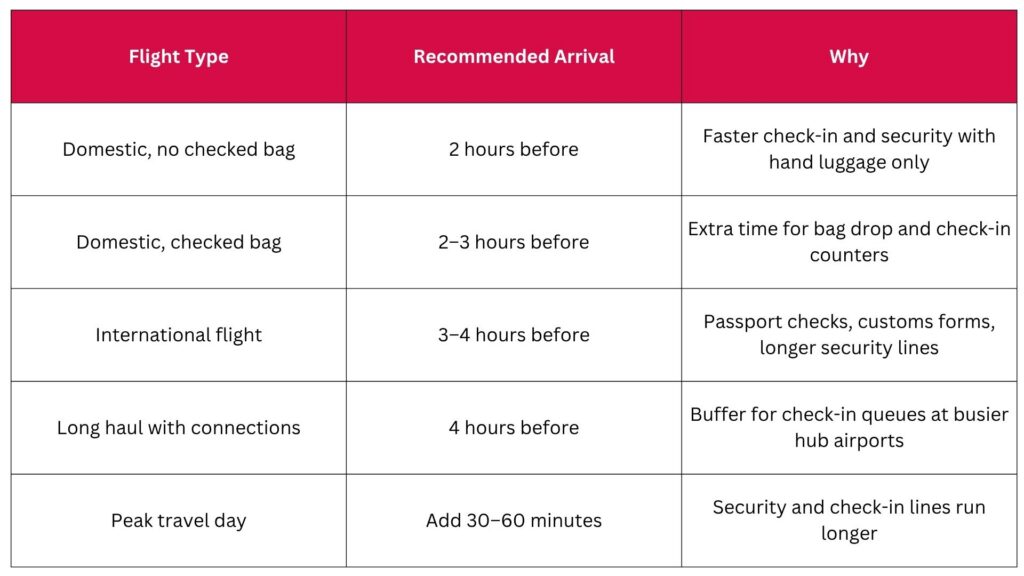
For most domestic flights, plan to arrive 2 to 3 hours before departure and for international flights, aim for 3 to 4 hours – earlier if you’re checking a bag, traveling on a busy travel day or flying out of a large or unfamiliar airport.
That’s the short answer. But “2 to 3 hours” or “3 to 4 hours” can mean very different things depending on where you’re flying from, whether you’ve already checked in online and how the parts of travel like parking, check-in, security and the walk to your gate add up on the day. This guide focuses on the full airport-day timeline; for airline-by-airline check-in cutoffs, see our companion guide on how early you can check in for a flight.
Recommended Arrival Times by Trip Type
Domestic Flights: How Much Time You Need
For a domestic flight, most airlines recommend arriving 2 to 3 hours before departure. That covers:
- Parking or drop-off and getting into the terminal
- Checking a bag, if you have one
- Making it through the security line
- Walking to your gate, which can take longer than you’d expect at large airports
If you’re traveling with only a small bag as carry-on and you’ve already checked in on your phone, you can lean toward the lower end of that window. If you’re checking a bag, add extra time as bag-drop counters often close 30-45 minutes before departure, and once that cutoff passes, no amount of hurrying gets you on the plane. If you’re unsure how much you can bring or what it costs to check a bag, our baggage allowance guide breaks that down.
International Flights: How Much Time You Need
International travel takes longer at almost every step, which is why the standard advice is 3 to 4 hours before departure. Here’s where that time actually goes:
- Check-in and bag drop: international counters often ask for passport verification, visa checks or destination paperwork, which takes longer per traveler.
- Security screening: international terminals tend to have higher passenger volume and, at some airports, additional screening steps.
- Passport control: if you’re flying out of a country with outbound passport checks, this adds another queue before you even reach your gate.
- Larger terminals: international gates are frequently located further from check-in, especially at major hub airports.
If your international trip includes a connection, especially one where you’ll need to clear security again or change terminals, four hours is a safer target than three. Building in extra time here protects the flight deal you booked a missed connection because of a tight airport arrival time usually costs more, in rebooking fees and lost travel days, than the cheap flights it took to get that price in the first place.
Flying to Europe? Budget Extra Time for the EU Entry/Exit System
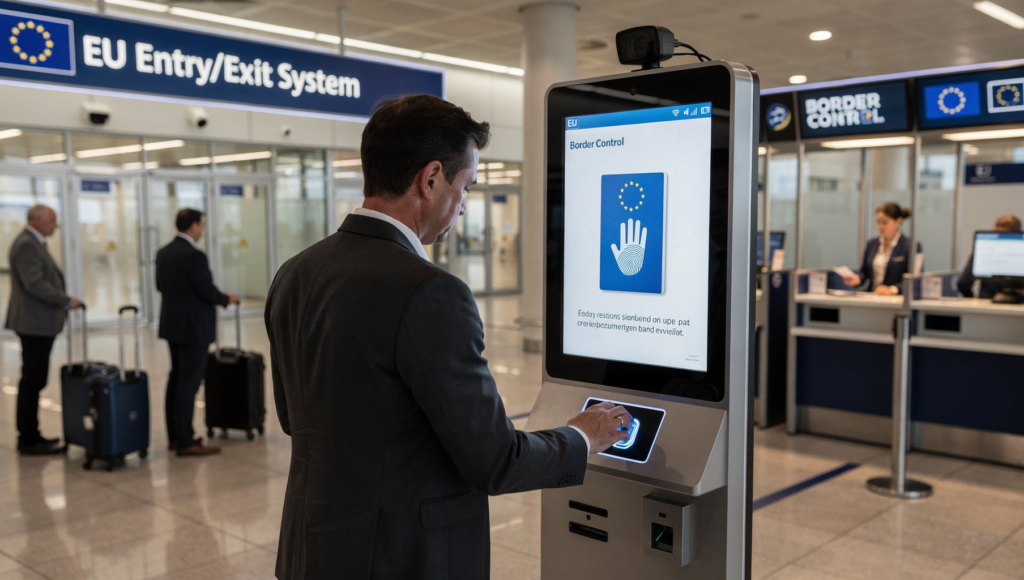
If your international flight is headed to the Schengen area which is most of the EU plus Iceland, Liechtenstein, Norway and Switzerland, build in extra time at the border, not just at your home airport. The EU Entry/Exit System (EES), a new digital border system, started on 12 October 2025 and has changed how non-EU travelers, including UK and US passport holders, are processed on arrival.
On a first visit under EES, you may be asked to register your fingerprints and have your photo taken at a border kiosk, rather than simply getting your passport stamped. There’s no cost and nothing to do in advance, but the checks can take noticeably longer than the old manual stamp, especially during busy travel periods, so it’s worth padding your arrival estimate on the Schengen side of the trip, not just before departure. Once registered, your digital record is valid for three years, and subsequent trips should move faster.
What Affects Your Ideal Arrival Time
The 2-to-3-hour and 3-to-4-hour guidelines are a starting point. A few things can push your ideal arrival time earlier:
You have a checked bag.
You should factor in time to drop your checked bag off before going through security.
You’re flying on a peak travel day.
Fridays, Sunday and the days around major holidays bring longer lines almost everywhere. Add 30 to 60 minutes to your usual buffer on these days.
You’re unfamiliar with the airport.
A layout you don’t know, combined with a large terminal, means more time spent finding your gate. Give yourself extra room the first time you fly through an airport, even if the flight itself is domestic.
You’re traveling with a group or with kids.
Larger groups move through check-in and security at the pace of the slowest member so build in extra time so the traveling experience stays relaxed rather than rushed.
Check-In, Security and Boarding: The Full Timeline
Check-In Cutoff Times
Check-In Cutoff Times
Check-in cutoffs vary by airline and airport. In the US, Delta requires domestic check-in at least 30 minutes before departure without a bag, 45 minutes with one and 60 minutes for international flights. American Airlines sets a flat 45-minute cutoff for domestic flights and 60 minutes for international ones. In the UK, British Airways closes check-in 45 minutes before short-haul departures and 60 minutes before long-haul departures from Heathrow and Gatwick, though this varies by airport. Always confirm your airlines specific policy before you travel
Checked-bag drop-off usually closes earlier than check-in itself. These cutoffs are set by the airline, not the airport, so check your specific airline’s policy when you book, especially if you found your ticket through a flight deal with a budget-friendly carrier that may have stricter rules. For a breakdown of cutoff times at major airlines, see our guide on how early you can check in for a flight.
Security Screening
Security wait times vary widely by airport, time of day and travel day. A quiet Tuesday morning might mean a 10-minute line; a holiday Sunday afternoon at a major hub can mean 45 minutes or more. A few habits speed things up:
- Wear slip-on shoes when possible
- Keep your laptop and liquids in an easy-access spot in your bag, not buried underneath everything else
- Empty your water bottle before the checkpoint
- Keep boarding passes and ID together and easy to reach
See our full guide on what you need to remove at security to speed your journey up.
Boarding and Gate Closure
Boarding typically begins 30–45 minutes before departure and airlines call it in groups. Gates commonly close 15–20 minutes before departure and once they close, a confirmed seat doesn’t guarantee a spot on the plane. Arriving at your gate with time to spare means you’re not the traveler running down the terminal, and it gives you a few minutes to check your phone, use the bathroom, or grab a snack before flight.
Pro Tips for a Smoother Travel Day

A calm arrival at the airport isn’t just about timing. A few small habits make the whole travel day easier:
- Pack with packing cubes. They keep your small bag organized and keep dirty clothes separated from clean ones on multi-stop trips.
- Keep a credit card easy to reach. A quick coffee or snack before boarding shouldn’t mean digging through your bag at the register.
- Download a translation app before you leave. The Google Translate app works with limited signal once you’ve downloaded the language pack, which is useful the moment you land.
- Sort a local SIM card or eSIM in advance. Landing with working data means finding ground transportation or street food recommendations without hunting for Wi-Fi.
- Check in online the night before. This alone can save 15–20 minutes at the airport.
Read more tips on airline arrival time.
Don’t Forget: Airport Day Checklist
☐ Passport, ID, and boarding pass (digital and printed backup)
☐ Checked bag secured with a Travel Sentry TSA lock
☐ Liquids in a clear bag, within size limits, for easy access at security
☐ Water bottle empty before the checkpoint
☐ Phone charger and a portable battery for a long haul flight
☐ Snacks for the gate or the plane
☐ SIM card or eSIM set up for your destination
☐ Copy of your packing list, in case you need to check anything off after a bag search
There’s no single correct arrival time for every trip but there is a reliable way to find yours. Start with 2 to 3 hours for domestic flights and 3 to 4 for international ones, then adjust up based on whether you’re checking a bag, flying on a busy day or navigating an airport you don’t know well. The extra 30 minutes you spend waiting at the gate costs you far less than the stress of sprinting to make a flight.
Frequently Asked Questions
How early should I arrive at the airport for a domestic flight?
Arrive 2 to 3 hours before a domestic flight. Add extra time if you’re checking a bag or flying during a peak travel period.
How early should I arrive at the airport for an international flight?
Arrive 3 to 4 hours before an international flight to allow for check-in, passport control, and typically longer security lines.
What happens if I arrive at the airport too late?
If you arrive after the airline’s check-in or bag-drop cutoff, you may be denied boarding even with a confirmed ticket. Gates also close 15–20 minutes before departure, and being at the gate after that point usually means missing the flight.
Does arrival time change if I only have a carry-on bag?
Yes. Skipping bag check saves time, so travelers with only a small carry-on can often arrive closer to the lower end of the recommended window, around 2 hours for domestic flights.
Is it safe to lock a checked bag if TSA might need to search it?
Yes. A Travel Sentry TSA lock allows screeners to open and relock your bag during an inspection using a special tool, without needing to cut the lock. Look for the red diamond logo to confirm the lock is genuine.
Should I arrive earlier during holidays or weekends?
Yes. Add 30 to 60 minutes to your usual arrival time on peak travel days, when check-in and security lines are typically longer.
Related Articles
September 2026
Flight Cancellation Compensation: What Are Your Rights?
Find out your flight cancellation rights and how to claim compensation.
Read More
September 2026
Can You Take Power Banks on a Flight
Learn airline specific rules for carrying power banks on flights and battery capacity limits.
Read More
September 2026
What Do You Have to Remove at Airport Security?
What comes off, what comes out of your bag and what you can skip if you've got PreCheck.
Read More


